
Sales & customer conversations
Updated October 2026
EchoDepth, from Cavefish, analyses the communication signals in sales demos, discovery calls and customer service interactions. It returns coaching notes and timestamped evidence for sales directors, contact centre leaders and compliance teams, not keyword summaries.
Sales call analysis in 90 seconds
How EchoDepth reads every sales call, tells speakers apart, and shows where interest is lost, frustration builds and deals stall. Figures in the video are illustrative.
Read the transcript
Your sales team spends hours on calls every day. Almost none of it is ever heard again. A few get sampled, the rest are gone, and with them the reasons deals stall.
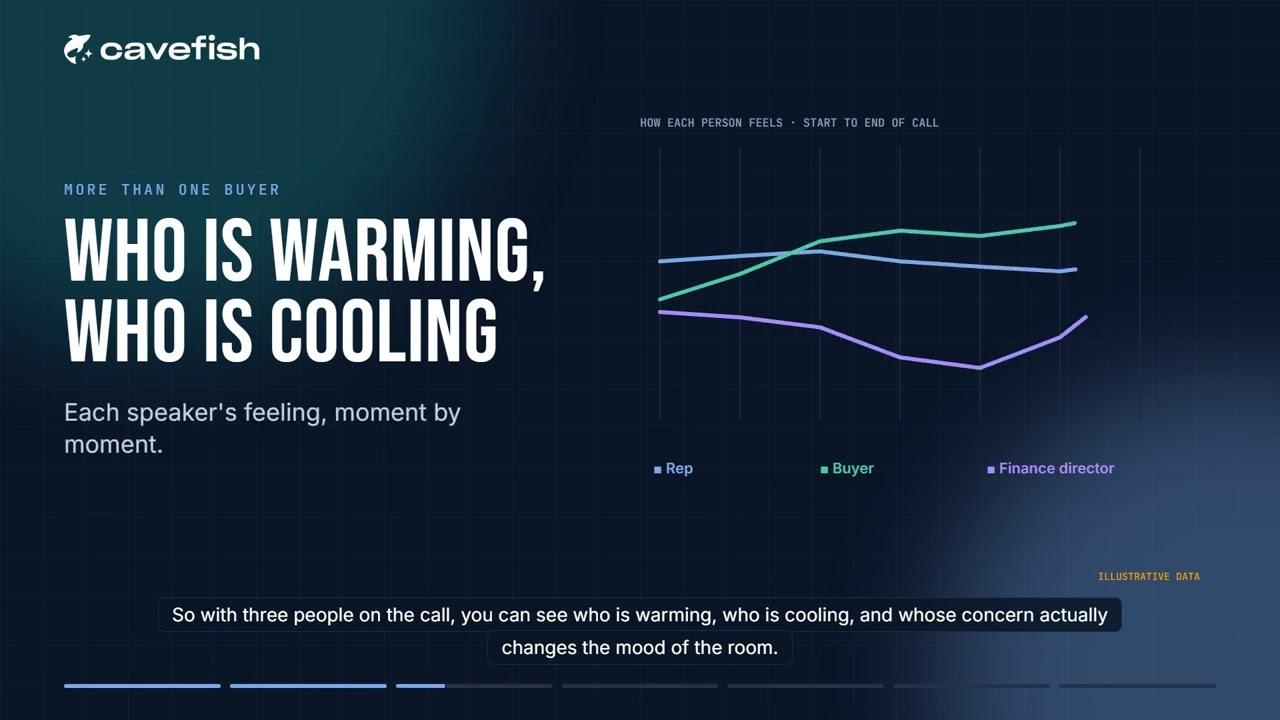
EchoDepth reads every sales call from start to finish. It tells the speakers apart, your rep, the buyer, and anyone else who joins, and measures how each of them feels, moment by moment.
So with three people on the call, you can see who is warming, who is cooling, and whose concern actually changes the mood of the room.
It shows you where interest is lost. The line drops when the price comes up before the value, or when the rep talks for too long, and you can jump straight to that moment in the call.
Across hundreds of calls, the patterns appear. The same frustration at the same step. The same objection, in the same words, just before a deal goes quiet.
Frustration is flagged in the calls where it happens, so managers coach the moment, not the whole hour.
And what comes back isn't another dashboard. It's the calls worth reviewing, the lines to change, and the questions that keep buyers engaged.
See where a sales call turned
EchoDepth reads calls, discovery conversations and demos for the signals linked to trust, engagement and buying intent, and shows where engagement dropped.
Read the transcript
Two calls, same product, same script, same question from the customer. One closes, the other doesn't. Call analytics can tell you what customers asked for. It can't tell you how they felt when they asked or the moment they went cold.
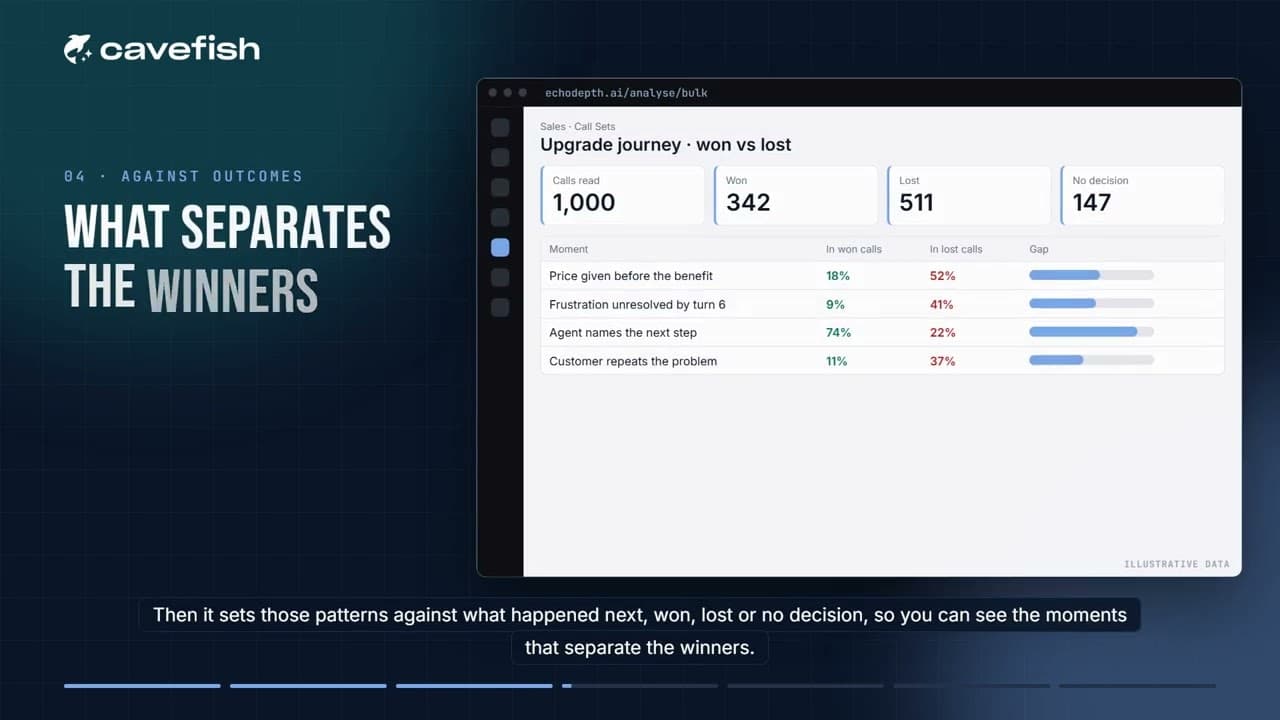
EchoDepth for sales reads every call sentence by sentence. What was said, how it was felt, and exactly where the conversation turned. Then it sets those patterns against what happened next, won, lost, or no decision. So you can see the moments that separate the winners.
It picks up the language buyers use when they're about to commit or about to hesitate and suggests the question a rep could ask next. And what comes back isn't another dashboard, it's the script lines to change, the coaching each team needs, and the calls that prove it. EchoDepth for sales, find out what your winning conversations have in common. See what your customers feel.
Applications
Where sales and CX teams use EchoDepth communication signal analysis.
Sales demo coaching
Analyse recorded demos for buyer signal drops, objection moments and delivery gaps. Give sales directors timestamped evidence for coaching - not rep self-reporting.
Discovery call analysis
Surface the moments in discovery calls where prospect trust dropped, questions were deflected or buying signals appeared. Coach from signal data, not memory.
Contact centre quality
Flag vulnerability signals, agent stress and compliance risk moments in submitted recordings. A planned API would extend this to high volumes. Prioritise coaching queues with objective signal evidence rather than random sampling.
Agent fatigue detection
Identify when agents are operating under sustained cognitive load - before it affects customer experience or compliance. Evidence-based rostering and support decisions.
Objection signal mapping
Identify which objection types appear at which moments in the sales narrative. Build a signal-based objection map for the sales playbook rather than guessing from memory.
Post-call vulnerability review
After interactions with potentially vulnerable customers, receive a scored analysis of the conversation signals - auditable Consumer Duty evidence with timestamp precision.
Common questions
How does EchoDepth improve sales demo conversion?
EchoDepth analyses recorded demos for buyer signal patterns - identifying moments where prospect engagement dropped, objection signals appeared or the narrative lost credibility. Sales directors receive timestamped, coaching-ready evidence, not rep self-reporting.
Can EchoDepth monitor customer service conversations at scale?
Yes. EchoDepth analyses submitted conversation recordings - flagging vulnerability signals, agent fatigue and compliance risk moments. Used for FCA Consumer Duty evidence, quality assurance and coaching prioritisation.
What is the difference from standard conversation analytics?
Standard platforms analyse what was said - keywords, topics, compliance phrases. EchoDepth also analyses how it was said - delivery signals indicating genuine conviction, stress, vulnerability or disengagement that keyword analysis cannot detect.
What is sales call analysis?
Sales call analysis reads recorded sales calls to show what was said, who said it and how it landed. EchoDepth by Cavefish reads every call from start to finish and measures how each speaker feels, moment by moment, so you can see where a conversation turned.
How do you find where a buyer loses interest on a call?
Look at the buyer’s emotional line across the call rather than the transcript alone. EchoDepth plots it and marks the drops, such as price coming up before value, or the rep talking for too long. You can then jump straight to that moment in the recording.
Can it analyse calls with more than one buyer?
Yes. EchoDepth tells speakers apart, so your rep, the buyer and anyone else who joins are each read separately. You can see who is warming, who is cooling and whose concern changes the mood.
How does it spot frustration?
It measures frustration in the buyer’s voice and words and flags it in the calls where it happens. Managers can coach the specific moment instead of reviewing the whole call.
Can it find patterns across many calls?
Yes. Across large sets of calls it shows where the same frustration appears at the same step, and which objections come up before deals go quiet.
Do customers have to fill in a survey?
No. EchoDepth reads the calls you already have, so nobody is surveyed.
What do you get back from a sales call analysis?
Not another dashboard. You get the calls worth reviewing, the lines to change and the questions that keep buyers engaged.
What can be detected in sales and customer service calls beyond what was said?
EchoDepth detects how something was said, not only what was said, in sales demos, discovery calls and customer service interactions. Standard conversation analytics tracks keywords, topics and compliance phrases, whereas EchoDepth also reads delivery signals that indicate genuine conviction, stress, vulnerability or disengagement, which keyword analysis cannot detect. In sales calls it identifies buyer engagement drops, objection moments, and points where prospect trust fell or buying signals appeared, and it can map which objection types appear at which moments in the narrative. In customer service it flags vulnerability signals, agent stress and fatigue, and compliance risk moments in submitted recordings. Sales directors and contact centre leaders receive timestamped evidence for coaching, and compliance teams receive scored, auditable evidence for FCA Consumer Duty review. Coaching priorities can be set from objective signal evidence rather than random sampling. A planned API would extend this to high volumes. Reports return within 5 working days of submission.
Analyse a sales conversation
Submit a demo recording, discovery call or customer interaction. Receive a scored EchoDepth report within 5 working days.