
Message testing &
insight
Updated October 2026
EchoDepth, from Cavefish, tests how campaigns, scripts and communications will land with audiences before they go live. It returns scored, timestamped signal data from real content for marketing, communications and research teams, not stated recall or claimed response.
Know how a message will land before it goes live
Resonance, credibility and engagement, scored on the draft - for leadership announcements, investor presentations and brand messaging - with the moments to revise.
Read the transcript
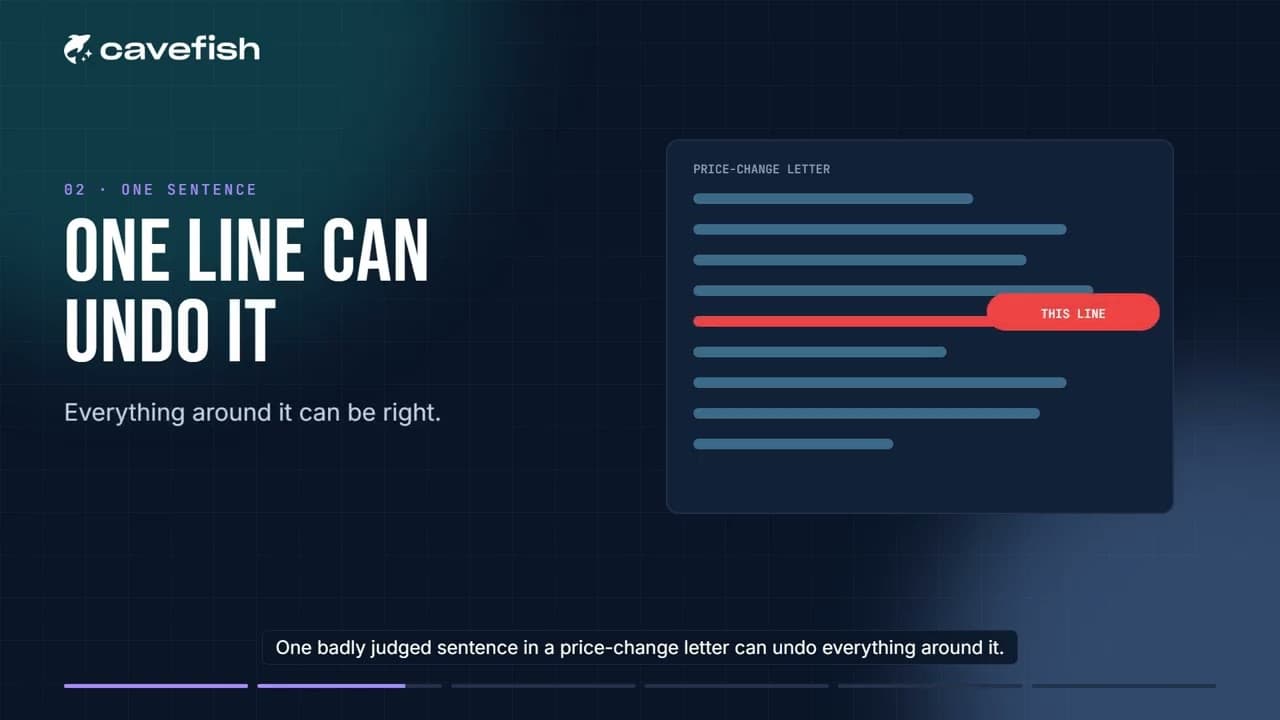
Most messages are checked for accuracy, tone, and legal risk. How they actually feel is found out later in complaints, calls, and cancellations. One badly judged sentence in a price change letter can undo everything around it. Echo depth for comms reads your draft sentence by sentence for the feeling each line creates before it goes out.
It names the line most likely to cause a reaction and suggests a rewrite scored against the original on the same scale. Your tone of voice becomes a measurable profile, so every writer sounds like one organization across one letter or a whole template library. Echo depth for comms, know how a message lands before you send it. See what your customers feel.
Traditional research tells you what people say they felt. Not what actually happened.
Focus groups, claimed recall and post-exposure surveys all share the same flaw: they measure what participants choose to report, filtered through social desirability, memory and the moderator's framing.
EchoDepth measures the communication signals that occur in the moment of exposure - facial delivery response, vocal pattern and linguistic signal - returning a timestamped record of what the content actually produced, not what the audience later decided to say about it.
What people say they felt in a focus group diverges significantly from their signal response at the moment of exposure. EchoDepth closes that gap.
Results are returned at the second level - you know exactly which frame, line or transition caused a credibility drop or trust peak.
Scored, documented outputs that can be presented to boards, clients or media buyers as objective evidence rather than interpreted opinion.
Use cases
Where organisations use EchoDepth for message testing and insight.
Campaign creative testing
Test TV, digital and social creative against real audience signal before media spend commits. Identify which executions carry genuine emotional connection versus surface attention.
Script and voiceover testing
Compare script variants and voice talent against audience response data. Know which combination lands the intended message - scored, timestamped, evidence-based.
Leadership and CEO address
Before a major announcement goes to the whole organisation, test how it lands with a representative sample. Identify credibility drops, trust signals and the moments that need revision.
Investor and analyst communications
Test how guidance language, delivery pace and confidence signals in earnings narratives register before results day. Return confidence to the board.
Product and brand messaging
Test positioning statements, product launch scripts and brand narratives against signal data. Know what resonates versus what leaves audiences neutral before production spend.
Change programme communications
Before a transformation message reaches thousands of employees, test how it lands with a pilot group. Surface resistance signals, trust gaps and the specific language that is creating friction.
What you receive
Overall credibility measure for the content
Delivery quality timeline with drop identification
Which moments carried emotional connection
Specific timestamps where signal drops significantly
Specific revision recommendations for each issue
Side-by-side scoring of multiple variants
Common questions
What is the difference between EchoDepth message testing and traditional focus groups?
Focus groups capture what people say they felt. EchoDepth measures what actually happened in their communication signals as they experienced the content - vocal, facial and linguistic response at the moment of exposure. The two can complement each other: EchoDepth identifies which moments to probe in qual research rather than replacing it.
What types of content can EchoDepth test?
Campaign video and audio, scripts and voiceovers, recorded presentations, CEO and leadership addresses, campaign stills and creative, product launch content, investor communications and announcements. Any content where the emotional response of the audience matters to the outcome.
How quickly do message testing results come back?
Standard turnaround is 5 working days for a full scored report. Expedited analysis is available for time-critical campaign launches. Contact hello@cavefish.ai for urgent requirements.
Can consultancies use EchoDepth message testing in client projects?
Yes. EchoDepth is used by research and communications consultancies as an evidence layer within client engagements. Partners can access analysis outputs and white-label reporting, with planned API integration. See the Partners page for commercial terms.
How do you test how a message will land before it goes live?
EchoDepth measures the facial, vocal and linguistic signals an audience produces at the moment of exposure, rather than what people later say they felt. That is how EchoDepth, from Cavefish, tests how a campaign, script or communication will land before it goes live. Each analysis returns a 0–100 Trust Score, a per-second Credibility Signal, timestamped message resonance and risk moments, and coaching notes with specific revision recommendations. Teams can also request optional side-by-side scoring of variants. Results are returned at the second level, so a team can see which frame, line or transition caused a credibility drop or trust peak. Focus groups, claimed recall and post-exposure surveys share a different flaw, because they measure what participants choose to report, filtered through social desirability and memory. A full scored report is returned in 5 working days, and the outputs can be presented to boards, clients or media buyers as scored, documented evidence rather than interpreted opinion.
Test a piece of content
Submit a video, script or campaign creative for a scored report, or book a consultation to discuss your use case.