
AI agent assurance: who checks your AI’s customer conversations?
AI agents and chatbots now handle millions of customer conversations, fast and polite. But they don’t hear the pause, and they don’t notice “I’ll manage” when someone clearly can’t. Cavefish scores every AI conversation to the same standard as a human one, so you can see which left customers worse off, fix the agent, and hand the right conversations to a person.
One standard for human and AI conversations
Seventy seconds on what AI agents miss, why Consumer Duty still applies, and how scoring every AI conversation lets you fix the script and hand the right calls to a person.
Read the transcript
Every bank, insurer and utility is putting AI agents on the phones and in chat. Millions of conversations, handled in seconds.
But who checks how the customer actually felt? An AI agent doesn't hear a pause. It doesn't notice "I'll manage" when someone clearly can't.
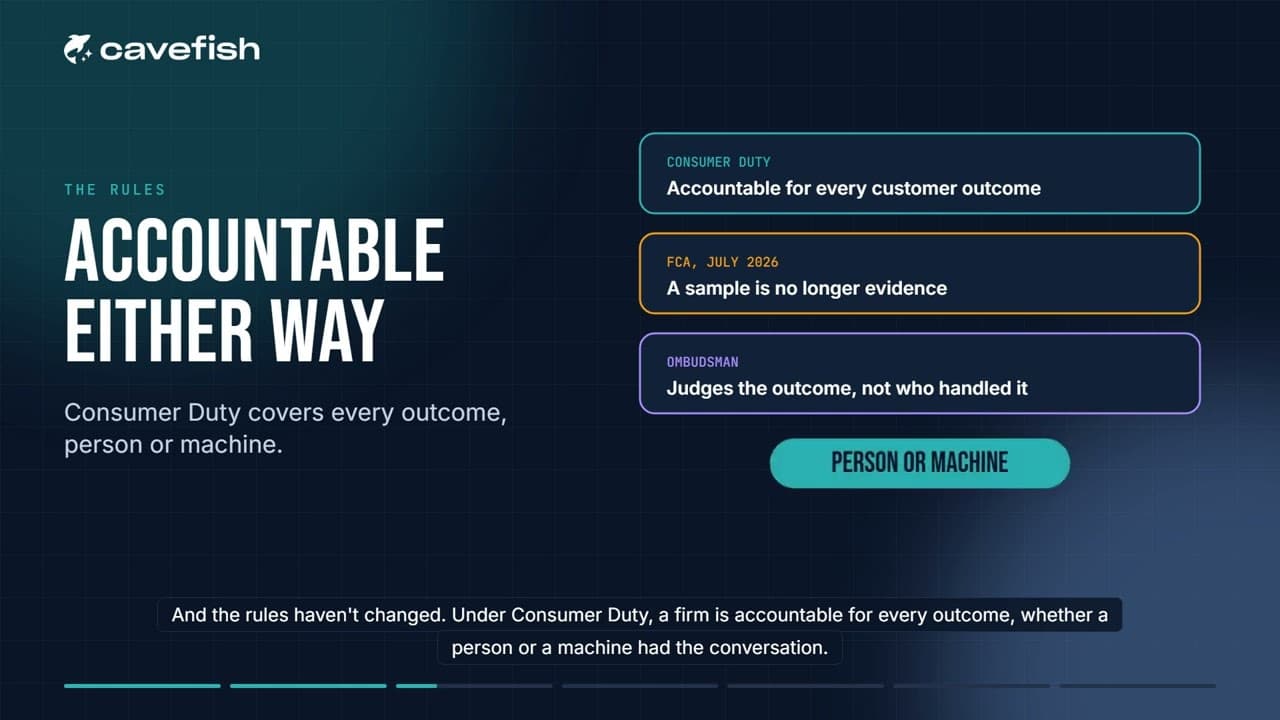
And the rules haven't changed. Under Consumer Duty, a firm is accountable for every outcome, whether a person or a machine had the conversation.
Cavefish scores every AI conversation to the same standard as a human one: what the customer said, how they said it, and the gap between the two.
So firms can see which AI conversations left customers worse off, fix the agent's script, and hand the right calls to a person, in the moment.
As AI takes on more of customer contact, the volume grows with it. Every conversation scored is a conversation evidenced.
The Communication Risk Index. Assurance for every conversation, human or AI.
What an AI agent misses
An agent can give the right answer and still leave the customer worse off. The warning signs are rarely in a single message; they build across the conversation, in how the customer replies.
The pause
A long gap before the reply, or a reply that trails off. In chat it shows as a slow, short answer after a long one.
“I'll manage”
Minimising phrases - “never mind”, “it's fine”, “don't worry” - when the problem is plainly not solved.
Going round in circles
The same question asked a second and third time, in slightly different words, because the first answer didn't help.
Rising frustration
Replies that get shorter and sharper over several turns, long before the customer says they want to complain.
Signs of vulnerability
Money worries, illness, bereavement or confusion, often never stated outright but visible in how the customer writes or speaks.
Consumer Duty doesn’t change when a machine answers
Under the FCA’s Consumer Duty, firms must deliver good outcomes for retail customers and be able to show it. The Duty is about the outcome, not the channel: a firm is accountable whether a person or an AI agent had the conversation.
Human conversations are usually sampled, scored and coached. AI conversations often aren’t, because there are too many and the agent never has a bad day. That is exactly where outcomes can slip unseen: a polite, correct, fast answer that leaves a struggling customer without help. Scoring every AI conversation to the same standard closes that gap and leaves a record that it was checked.
What you get
Cavefish reads what the customer said, how they said it, and the gap between the two, then turns it into decisions about the agent rather than a dashboard to watch.
A score for every conversation
Each AI conversation is read and scored to the same standard as your human conversations, so the two can be compared like for like.
The conversations that went wrong
A ranked list of AI conversations that left customers worse off, with the moments that drove each reading.
Script fixes
The parts of the agent's flow that most often lead to frustration or confusion, so you change the agent rather than chase individual chats.
Handover rules
When to pass a conversation to a person - for example rising distress, a vulnerability signal or a complaint in the making.
Consumer Duty evidence
A record that AI-handled conversations were assessed for outcomes, and what happened next.
How it works
- Send the conversations. Transcripts from your chat or voice platform, as an export or through the EchoDepth REST API. Human conversations can go in alongside, so both are scored the same way.
- Every conversation is read. Emotion, frustration, confusion and vulnerability signals across the whole exchange, not keywords in single messages.
- See where it went wrong. The conversations that left customers worse off, the moments that drove each reading, and the parts of the agent’s flow behind them.
- Fix and route. Change the agent’s script, set the rules for handing conversations to a person, and keep the record for Consumer Duty.
Common questions
What is AI agent assurance?
AI agent assurance is checking that conversations handled by an AI agent or chatbot leave customers no worse off than a conversation with a person would. Cavefish reads each AI conversation for what the customer said, how they said it and the gap between the two, and scores it to the same standard used for human conversations.
Does Consumer Duty apply to conversations handled by AI?
Yes. The FCA's Consumer Duty is about outcomes for customers, not who or what delivered them. A firm is accountable for every outcome, whether a person or a machine had the conversation, so AI-handled contact needs the same evidence of good outcomes as any other channel.
How can you tell if a customer is struggling with a chatbot?
The signals are in the language. A customer repeating the same question, replies getting shorter, frustration building over several turns, or minimising phrases such as "I'll manage" or "never mind" when the problem is plainly not solved. An AI agent can answer politely and still miss all of these; Cavefish reads them across the whole conversation.
When should an AI conversation be handed to a person?
When the reading shows the customer is confused, frustrated, distressed or showing signs of vulnerability, and especially in sensitive moments such as complaints, money worries or a declined request. Cavefish flags those conversations so they can be routed to a person, and shows which parts of the agent's script lead to them most often.
Is this the same as monitoring the AI for accuracy?
No. Accuracy checks ask whether the agent gave the right answer. Assurance asks how the customer felt and whether they were left worse off. An answer can be correct and still land badly; Cavefish measures the second question, which is the one Consumer Duty cares about.
What data does it need, and where is it processed?
Conversation transcripts from your chat or voice platform, by export or through the EchoDepth REST API. Data is processed in the UK under UK GDPR, and Cavefish is registered with the ICO (ZB915633). Cavefish flags; your people decide what happens next.
How do you check the quality of AI agent and chatbot conversations?
Score every AI conversation to the same standard as a human one, for how the customer felt rather than only whether the answer was correct. Cavefish reads what the customer said, how they said it and the gap between the two, flags the conversations that left customers worse off, shows which parts of the agent’s script caused them, and identifies the conversations that should be handed to a person. Under FCA Consumer Duty, that gives firms evidence of outcomes across AI-handled contact as well as human.
See how your AI conversations are landing
Send a sample of AI agent or chatbot transcripts, and we will show you which conversations left customers worse off, and why.