
Vulnerable client signals your team can't currently see. EchoDepth makes them visible.
Updated October 2026
FCA Consumer Duty requires documented evidence that vulnerable customers received appropriate treatment. Standard QA reviews only a sample of interactions, so vulnerability signals in the rest often go unseen.
EchoDepth analyses voice, video and text in real time - detecting distress, anxiety and cognitive overload before harm occurs, and generating the audit trail your compliance team needs.
Hear who needs more care
Many vulnerable customers never say so. How EchoDepth reads the signals in their calls, scores each interaction and keeps the audit record Consumer Duty asks for - with qualified staff making every decision.
Read the transcript
Under Consumer Duty, firms must deliver good outcomes for every customer. Including the ones who never say they're struggling.
Many won't tell you. Bereavement, illness, money worries. Some don't recognise it in themselves, and some don't want to say.
But it often shows in how they speak. The pace slows, the pauses grow, and the words start to change.
EchoDepth listens for those signals in every call. Distress, anxiety and cognitive overload, from vocal patterns, pace, hesitation and language. No declaration needed.
Each interaction gets a Vulnerability Signal Score, with the moments that drove it, timestamped.
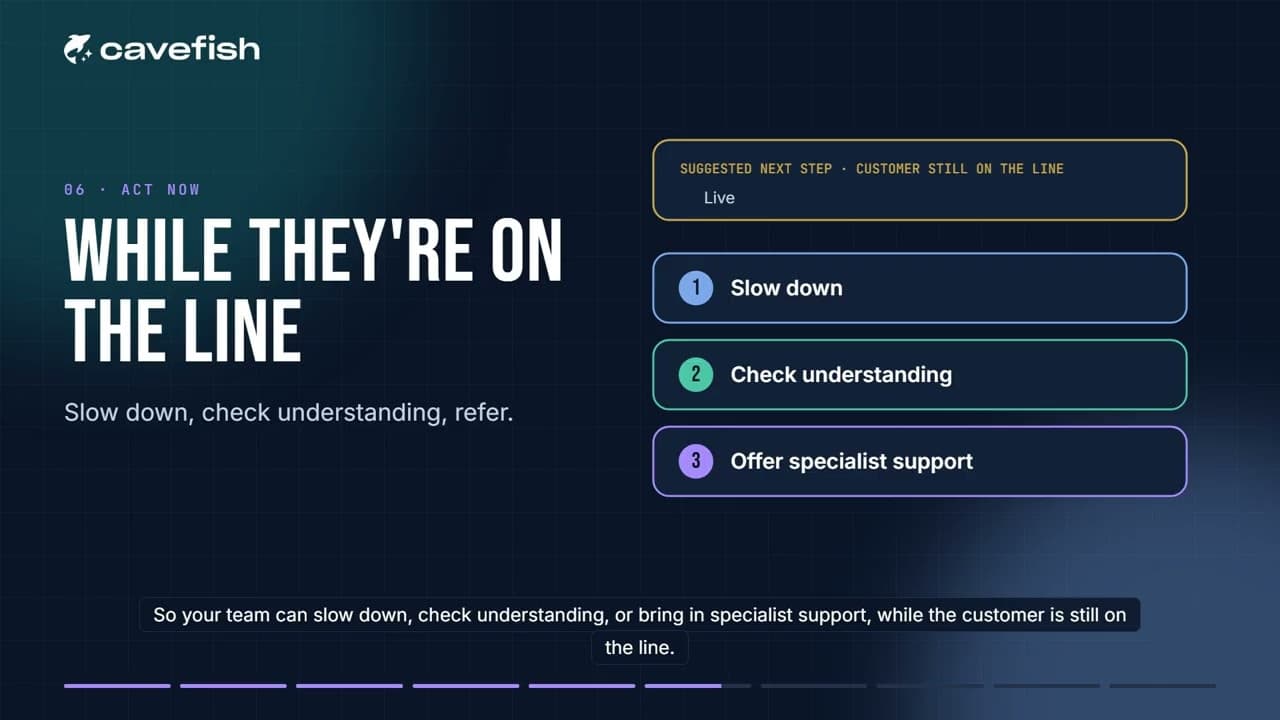
So your team can slow down, check understanding, or bring in specialist support, while the customer is still on the line.
And every call leaves an audit record: vulnerability was assessed, and here's what happened next. That's the evidence Consumer Duty asks for.
It matters most where harm is likeliest. Collections, complaints, and difficult decisions like a loan decline.
EchoDepth flags. People decide. Every determination stays with qualified staff, under UK GDPR, with consent built in.
EchoDepth. Hear who needs more care, while there's still time to give it.
Four-tier framework. Automatic routing.
EchoDepth classifies every interaction against a validated vulnerability tier framework - triggering the appropriate response before harm occurs.
No elevated emotional markers. Standard interaction protocol.
Elevated arousal or low valence. Continue with care. Note in case file.
Significant distress markers. Route to trained handler. Pause recovery action.
Extreme distress or crisis-level signals. Immediate escalation. Signpost specialist support.
Designed for where the risk is highest.
Complaint Escalation
ECA escalations are rarely surprises to the customer. The emotional signals - frustration, distress, a sense of being dismissed - build across every interaction. EchoDepth reads those signals in real time, giving your team the chance to intervene before a complaint becomes a regulatory case.
Loan Decision Communications
A loan decline is not just a business decision. For many customers, it arrives at a moment of genuine financial crisis. EchoDepth analyses the communication quality of video affordability interviews, flagging risk signals before a decision is communicated without appropriate care.
Debt Recovery Interactions
Vulnerable customers are disproportionately represented in collections portfolios - and disproportionately harmed by inappropriate treatment. EchoDepth provides collections teams with real-time vulnerability signals, flagging the moment they emerge so interactions can be redirected before harm occurs.
Fraud & Claims Investigation
Fraud investigators deal daily with distinguishing genuine distress from performed distress. EchoDepth adds a physiological layer independent of what the subject says - identifying moments where the emotional profile diverges from what a genuine account would produce.
The maths is straightforward.
Fewer escalations reduce remediation cost every year - before accounting for reduced FCA scrutiny, avoided fines and reputational protection.
Illustrative structure only. No modelled figures are presented as results; measure outcomes with your own data in a proof of concept.
Documented Consumer Duty evidence is your primary defence against enforcement action.
Intervening before harm occurs is generally less costly than post-complaint remediation.
Documented vulnerability assessment process demonstrates regulatory maturity to the FCA, boards and investors.
Every session generates a timestamped vulnerability assessment record - the audit trail Consumer Duty requires.
“EchoDepth does not detect lies. It measures the involuntary physiological markers that accompany stress, cognitive load and emotional state change. What organisations do with those signals is a matter of process, policy and human judgement.”
Cavefish ethics framework: this distinction is non-negotiable in every deployment
Common questions
How does EchoDepth support FCA Consumer Duty compliance?
EchoDepth detects emotional distress, anxiety and cognitive overload signals in customer interactions - generating a Vulnerability Signal Score and timestamped audit record for every session. This creates documented proof that vulnerability was assessed for every interaction, directly satisfying Consumer Duty evidencing requirements.
Does the customer need to self-declare vulnerability?
No. EchoDepth detects vulnerability signals from vocal patterns, speech pace, hesitation patterns and linguistic markers - without relying on customers to identify or disclose their own situation. This is particularly important for customers experiencing mental health challenges, bereavement or acute financial distress who may not recognise or wish to declare their vulnerability.
What modalities does EchoDepth analyse for vulnerability detection?
EchoDepth is voice-first for phone-based interactions - where most collections and complaint calls happen. It also analyses video (facial Action Units, expressions), text (transcripts, written communications) and still images. The modality is matched to the interaction type.
What is the typical ROI?
The return depends on your own volume of vulnerable-customer interactions, your current escalation rates and your remediation costs. A proof of concept on your own call data is the way to measure it.
Is EchoDepth GDPR compliant for financial services use?
Yes. Cavefish operates under UK GDPR and ICO frameworks (ICO registration ZB915633). All deployments include explicit informed consent architecture and a signed Data Processing Agreement. EchoDepth has been used within the FCA Regulatory Sandbox.
How does EchoDepth avoid becoming a substitute for human judgement?
EchoDepth generates evidence and flags - it does not make decisions. All vulnerability determinations, interaction redirects and customer outcomes remain with qualified staff. The platform provides the physiological evidence layer that supports human decision-making under Consumer Duty.
How does EchoDepth classify vulnerable customers?
EchoDepth classifies vulnerable customers by scoring every interaction against a four-tier vulnerability framework, and each tier triggers a defined response. Tier 0 is Standard, with no flag and the standard interaction protocol. Tier 1 is Elevated, which means monitor: elevated arousal or low valence is noted in the case file. Tier 2 is Financial Distress, which means intervene: significant distress markers route the interaction to a trained handler and recovery action is paused. Tier 3 is Crisis Indicators, which means escalate: extreme distress or crisis-level signals trigger immediate escalation and signposting to specialist support. Classification draws on vocal patterns, speech pace, hesitation patterns and linguistic markers, without relying on customers to declare their own situation. Every session generates a timestamped vulnerability assessment record, which is the audit trail Consumer Duty requires. EchoDepth provides the evidence and flags, and all vulnerability determinations remain with qualified staff.
See EchoDepth on a real customer interaction.
Submit a recording or transcript from a customer interaction. We return a full EchoDepth vulnerability analysis within 5 working days - free, no commitment.
ICO registered ZB915633 · FCA Regulatory Sandbox · UK GDPR compliant · hello@cavefish.ai